DFM in action: Evolving portfolios, enduring principles
The FNB Wealth & Investments DFM offering reflects an extension of traditional discretionary management — integrating strategic asset allocation, quantitative portfolio construction, forward-looking judgement and tactical flexibility within a single, governed decision-making framework.


In this Case Study, FNB Wealth & Investments demonstrates our DFM process in action - showing how disciplined asset allocation, manager selection, quantitative insight and strong governance can allow advisors to incorporate new ideas such as crypto without compromising long-term portfolio outcomes and maintaining a consistent investment process.
Case study: Crypto – where innovation meets discipline
When client questions vary, portfolio discipline shouldn’t
Markets don’t stand still, and neither do client conversations. Instead of following every trend, client conversations are opportunities to assess these within a framework designed to deliver long-term outcomes. This enables advisors to tackle these conversations head-on.
Crypto is certainly a fashionable trend—and a useful example to illustrate the point.
At FNB Wealth & Investments, the starting point is always the same: good portfolio decisions begin with process, not headlines. New ideas are assessed through a total-portfolio lens, with process applied consistently-regardless of market conditions.
Where outcomes really come from: SAA first
We start with Strategic Asset Allocation (SAA)—the north star of the portfolio. SAA defines achievable return objectives over realistic time horizons and within explicit risk budgets. Our framework uses a modified Black-Litterman approach, blending market-implied premia with forward-looking views and incorporating a degree of peer cognisance. The result is an allocation framework that is robust, repeatable and implementable across different risk profiles and portfolio styles.
The framework explicitly allows for differentiated conviction where the team has high confidence in prospective risk premia, while defaulting to market-implied returns where conviction is lower — ensuring discipline without forcing false precision.
Why it matters: SAA raises the probability of success and gives clients the requisite comfort required to remain anchored to long-term objectives through market stress.
“If you don’t know where you’re going, any road will get you there. To avoid every decision becoming purely reactive to market conditions we start with a well-defined SAA which guides our journey. This framework promotes a more measured response to market turmoil and a clearer focus on the client objective, separating the signals from the noise.”

Renzi Thirumalai, CIO at FNB Wealth & Investments
Case study: the client request
When a client asked whether digital assets such as bitcoin could be incorporated into their solution, the response was not a narrowly focused view on crypto. Instead, it was tested within the same strategic framework used for all portfolios, ensuring the discussion remained grounded in the probability of positive outcomes , risk budgets and overall portfolio construction.
Rather than debating the merits of any single asset class, the team reframed the discussion around one central question: what role could this exposure play in the context of the client’s total portfolio?
Quant insight: the total-portfolio lens
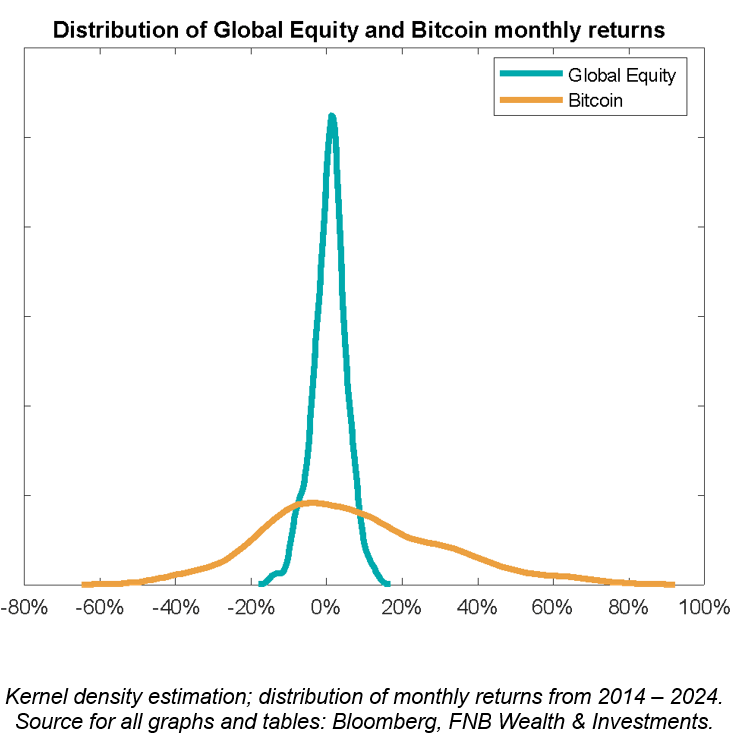
Quantitative analysis underpins the design of the SAA framework and evaluates how assets interact within a portfolio as a whole. The focus is on contributions to risk, diversification benefits, drawdowns and behaviour across market regimes—not headline returns. New ideas are only meaningful when viewed in the context of the broader portfolio and tested across different market scenarios.
“The question isn’t whether an asset has delivered high returns in isolation. What matters is how it changes the portfolio’s overall risk and return characteristics—especially in stressed environments.”

Luke Meiklejohn, Investment Strategist at FNB Wealth & Investments
This discipline allows the team to distinguish between volatility that creates opportunity and volatility that simply amplifies uncompensated risk.
Case study: evidence from modelling
Using long-run data (2012–2023), the team evaluated a baseline global portfolio against alternatives that included private credit, hedge funds and a small allocation to bitcoin. The results were instructive:
Baseline portfolio (global equity/bond mix): delivered solid returns but with higher drawdowns during stressed periods.
Portfolio B (including private credit and a small bitcoin allocation): asset class diversification improved risk-adjusted outcomes, producing a Sharpe ratio of ~0.88 vs. Baseline Portfolio’s ~0.53.
Portfolio C (adding private credit, a fund of hedge funds and equity long/short strategies, with a smaller bitcoin allocation): specific selection of hedge fund strategies delivered meaningfully improved portfolio volatility and drawdown characteristics, at a comparable Sharpe ratio.
While historical data informs our understanding of risk, correlations and drawdowns, portfolio construction is ultimately driven by forward-looking expected returns derived from a combination of market-implied premia and the team’s views where conviction is highest.
One of the clearest insights from the analysis was how even small allocations can materially influence portfolio outcomes.
The outcome was neither an endorsement nor a rejection of crypto, but a consciously bounded allocation reflecting both its potential as a return enhancer and the material uncertainty around its long-term risk characteristics.
The modelling shows that incorporating bitcoin only improves outcomes when position sizing, diversification and governance are tightly controlled—reinforcing that construction discipline matters more than conviction.
(Illustrative portfolios for discussion purposes only; past performance is not indicative of future results.)
Populating the solution: building blocks that “do what they say on the tin”
Once the strategic asset allocation defines where risk should be taken, the next step is deciding how that risk is implemented.
FNB Wealth & Investments applies a disciplined Manager Selection Framework to populate each asset class with fit-for-purpose building blocks. This provides a disciplined, repeatable decision-making framework designed to deliver consistency and resilience through evolving market environments.
The objective is to assemble building blocks that express specific portfolio roles with precision, consistency and resilience across market cycles.
The framework assesses managers across key criteria, including:
People
Experience, judgement, incentives and succession depth
Philosophy & Process
Clarity, repeatability and alignment with intended outcomes
Risk Management
How downside risk is identified and controlled across environments
Organisation & Governance
Stability, decision-making structures and oversight
Only managers that meet the required standards are approved for use and are subject to ongoing monitoring.
“The purpose of our manager selection framework is to reduce the risk of unpleasant surprises. Before we think about portfolio construction, we make sure the people, process and governance behind each building block are robust and repeatable.”
Carla de Waal, Head of Multi-Management and Manager Selection
Case study — balance, not binary
Rather than treating crypto as a binary decision, the evolving regulatory environment and available access vehicles were carefully assessed. This led to a measured, ring-fenced implementation, sized conservatively and governed within the portfolio’s overall risk budget.
Tactical flexibility within clear guardrails
While SAA anchors portfolios over the long term, Tactical Asset Allocation (TAA) allows for shorter term considered adjustments in response to valuations, macro developments and market dislocations—always within predefined guardrails.
“Periods of market stress often expose hidden correlations. A disciplined framework allows investors to respond thoughtfully to volatility rather than be driven by it.”

Nico Els, Multi-Asset Strategist at FNB Wealth & Investments
Purpose, Process, Patience
Volatility tests more than portfolios — it tests investor conviction.
For this reason, a disciplined, end-to-end investment process runs through every stage of portfolio construction, from asset allocation and manager selection to tactical decisions and ongoing monitoring, supported by strong governance. Its most enduring value is behavioural: preventing short-term emotion derailing long-term outcomes.
Staying invested, once the right portfolio is in place, remains one of the most powerful drivers of success.
Proof through consistency
FNB Wealth & Investments has been recognised at the Citywire South Africa DFM Awards, reflecting consistency across market regimes rather than reliance on a single successful idea. While awards are not the objective, they provide external validation of a disciplined, repeatable investment process.
The advisor takeaway
Client questions will change. What should not change is the framework used to answer them. That is the real value of our DFM offering: disciplined thinking, applied consistently, so clients can stay invested and advisors can focus on what matters most.
This approach brings structure to uncertainty—helping portfolios evolve without losing discipline.